SpY’s PANOPTICON Returns Madrid’s Public Space Through Surveillance Cameras
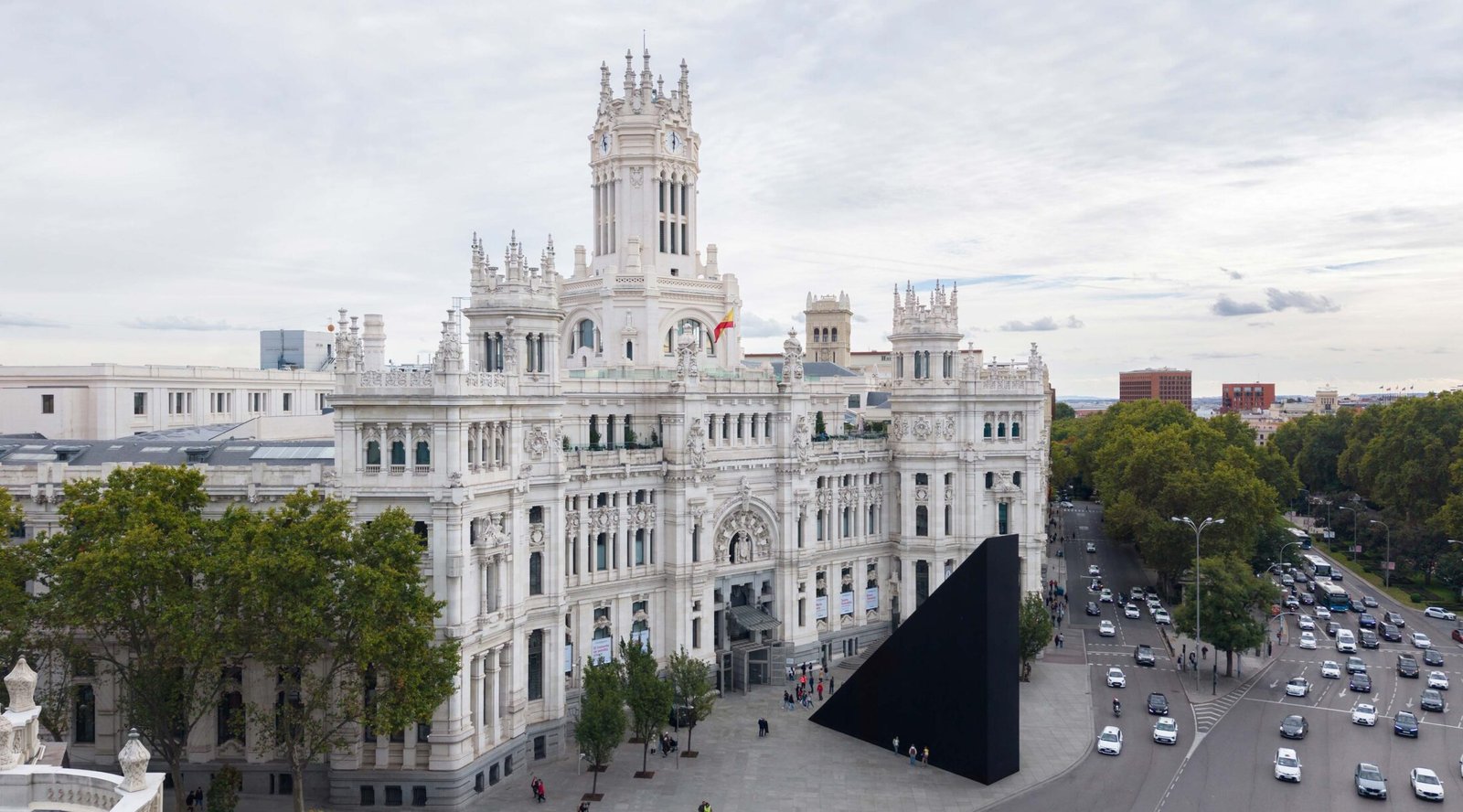
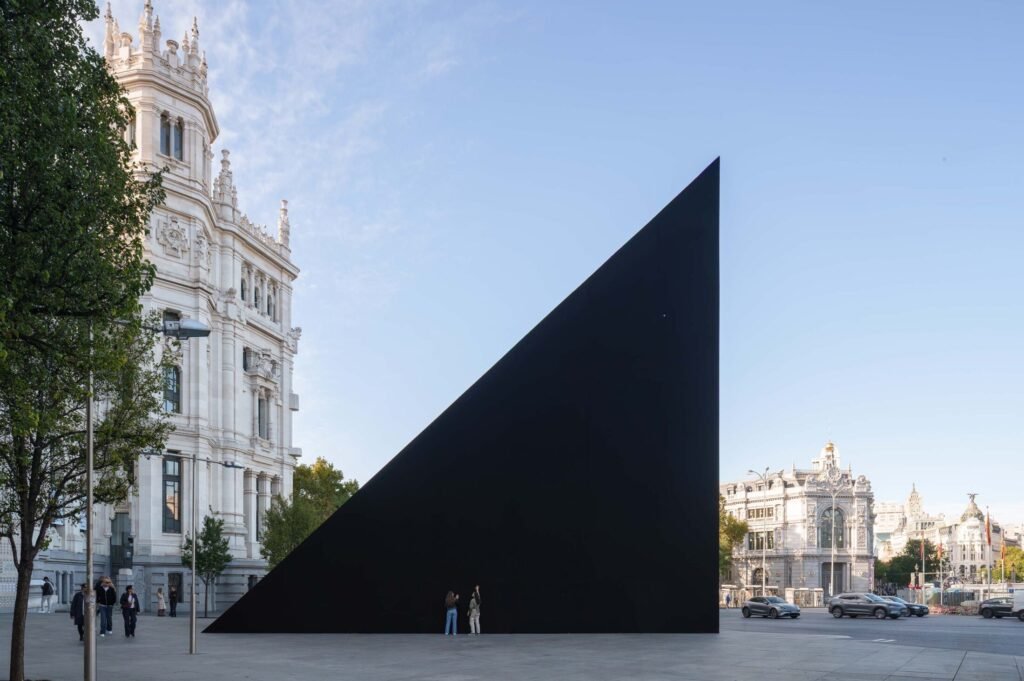
In front of Madrid’s Palacio de Cibeles, SpY’s PANOPTICON inserts a black triangle into one of the city’s most recognisable public settings. The temporary installation, documented by the artist as a 2026 work, measures twenty metres along each side. Its scale makes it an obstruction before it becomes an object to inspect.
The contrast is immediate. A sharply defined, dark surface interrupts the palace’s pale, densely articulated facade. Against that elaborate backdrop, the installation reduces its architectural language to an edge, a plane and a triangular profile. The surrounding buildings remain unchanged, but the usual view of them is displaced.
Moving around the perimeter reveals small viewing apertures. Screens inside are connected to CCTV cameras positioned at the top of the structure, returning live images of the surrounding architecture, pedestrians and traffic. The object conceals the direct view and then supplies a mediated version of the same place.
That exchange is the work’s central spatial mechanism. Visitors must approach the surface and choose a viewpoint rather than take in the square at a distance. A familiar urban scene becomes a sequence of partial images. The cameras offer an elevated perspective, but the person looking remains physically beside the wall, within the public space being recorded.
The title refers to the panopticon, the architectural model associated with the possibility of continuous observation. SpY brings that question into a civic setting through a combination of built form and ordinary surveillance equipment. The screens are not an additional display applied to a sculpture; they complete the relationship between what the structure blocks and what it lets people see.
The photographs also show how differently the intervention reads across the square. From a frontal viewpoint, its dark profile appears almost diagrammatic. From above, its footprint and proximity to traffic become clearer. Human figures at its base reveal the difference between the modest act of peering through an opening and the scale of the structure containing it.
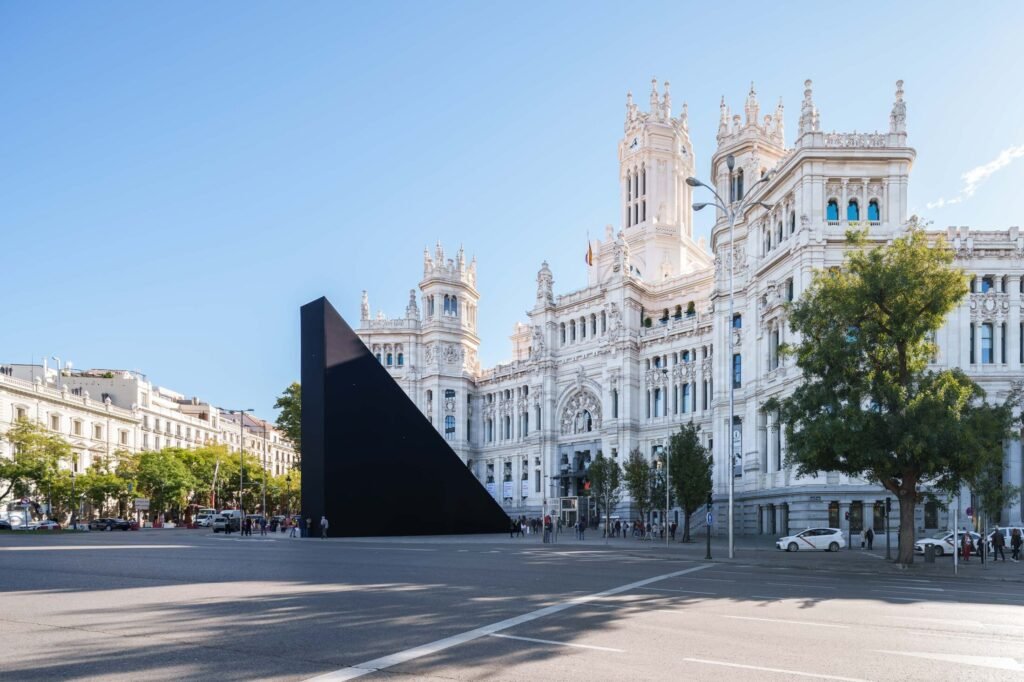
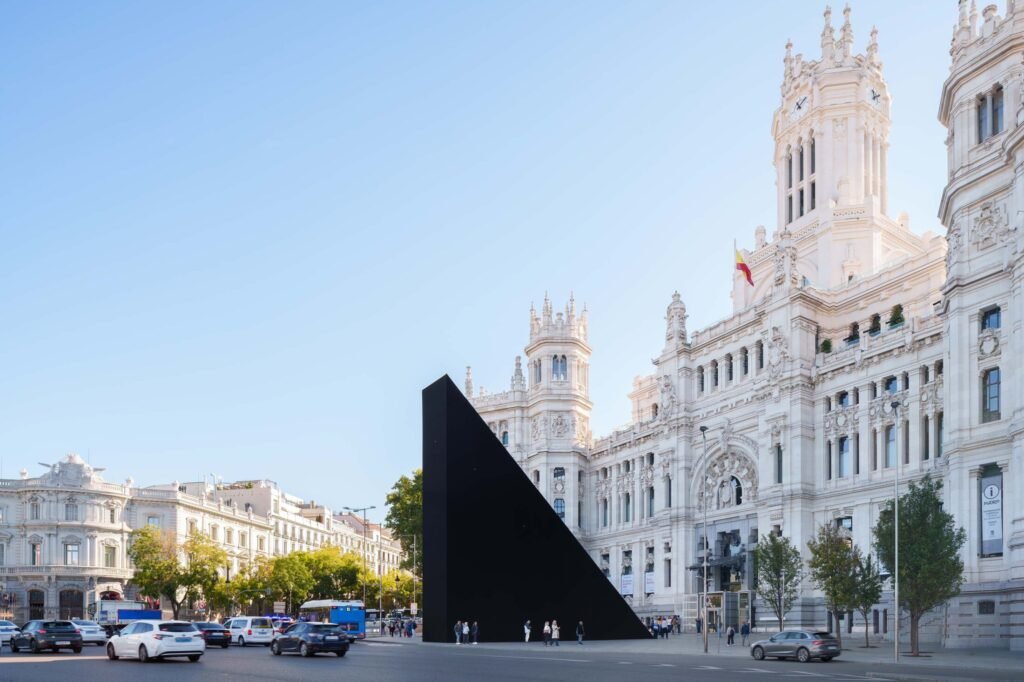
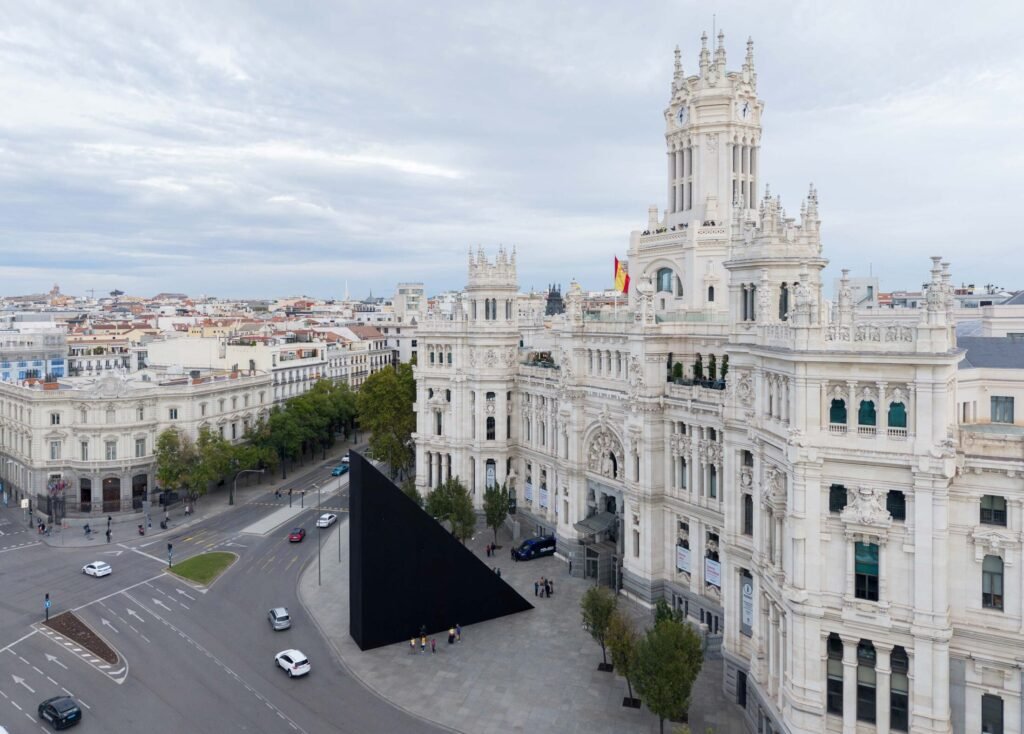
PANOPTICON makes a public-space argument through an encounter rather than a written explanation. Its architectural value lies in that precise sequence: interrupt a sightline, draw someone towards an opening, and return the city through a camera. The question of who observes whom becomes part of moving around the work.
Project information and photographs originate from SpY’s project gallery, with additional documentation in Designboom’s feature of 5 November 2026. Photographs shown here are credited to Rubén P. Bescós. This article documents the 2026 installation; current public visiting dates are not established by the cited project page.