Sabeel, Negotiated Builds a Public Fountain along an Informal Shortcut
Sabeel, Negotiated places shade, drinking water and movable seating along a route that neighbours already use through Al Qasimiyah School in Sharjah. Palestinian architect Samar Halloum developed the installation for the third Sharjah Architecture Triennial, which opened on 14 November 2026 under the theme Architecture Otherwise: Building Civic Infrastructure for Collective Futures. The project begins with observed movement rather than a new circulation diagram: informal shortcuts across the former school became its site and organising evidence.
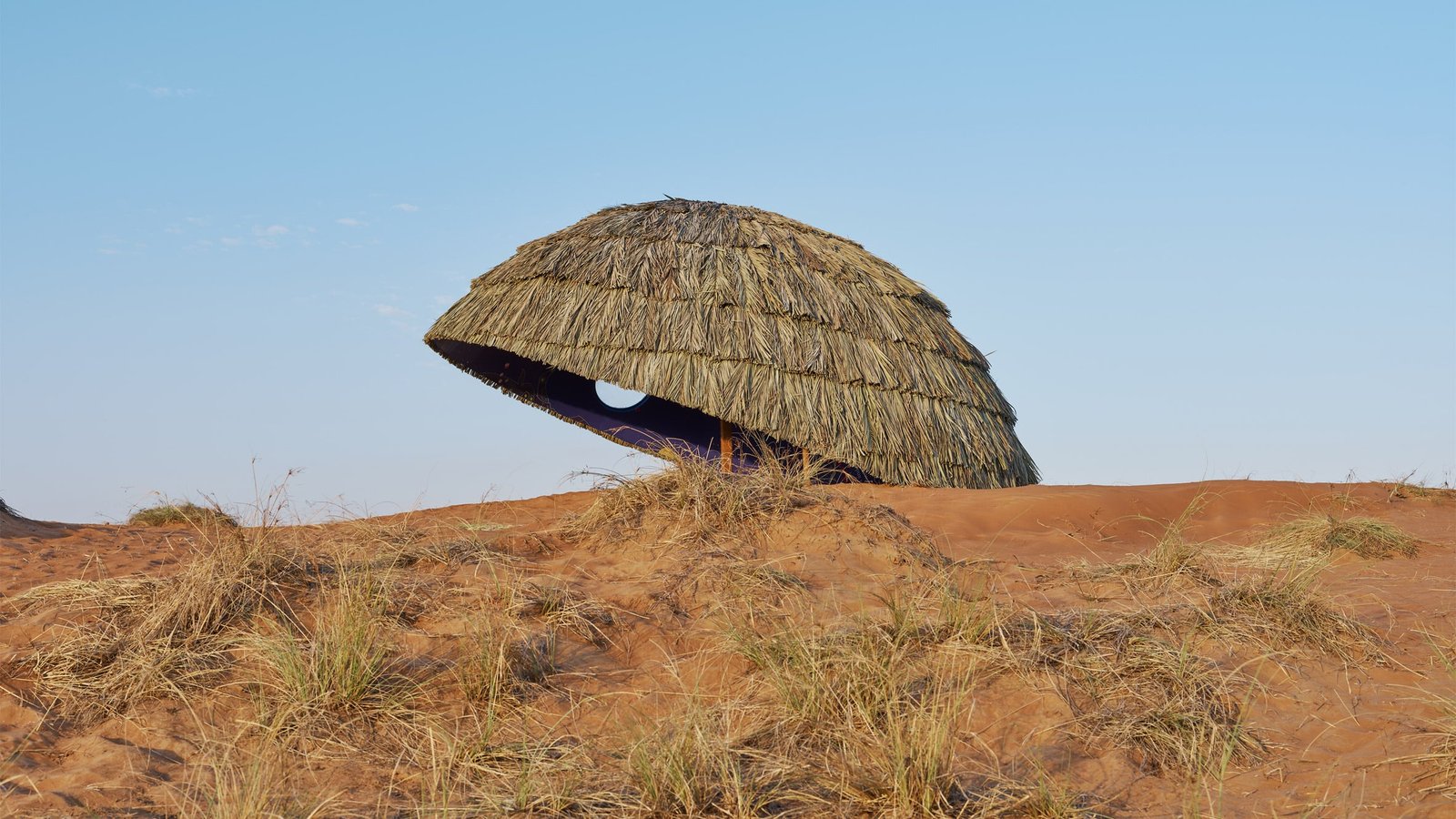
The title refers to the sabeel, the public drinking fountain historically found across the Gulf. Halloum expands that familiar amenity into a small gathering place. A brick pavilion and draped fabric canopy create shade, while a fountain and wooden stools allow people to stop, drink and rearrange the setting. Its scale is deliberately modest. The work does not close the route or formalise it as a monumental plaza; it adds support where walking and social contact already occur.
Fieldwork in Sharjah also informed a system of reconfigurable furniture incorporating debris gathered around the city. This use of found material links the installation to continual adjustment in a rapidly changing urban environment. The furniture can be moved by users, so occupation remains negotiable rather than fixed by the architect. Shade and water are treated as civic infrastructure whose usefulness depends on being placed along actual daily journeys.
The built installation changed in response to a disrupted regional supply chain. According to the Triennial’s curator, Vyjayanthi Rao, interruptions to brick production and delivery meant that Halloum could not rely on the specified quantity of conventional units. Leftover bales of cloth from another installation were cast in resin and used as substitute blocks. The adaptation is visible in the pavilion rather than disguised, turning shortage and coordination into part of its material record.
That negotiation between intention and circumstance gives the project its architectural value. The canopy, brickwork and furniture form a recognisable place, but none of them is treated as a complete object independent of use. Existing desire lines determine the plan; climate determines the need for pause; available materials affect construction; and movable stools leave the final social arrangement open.
Sabeel, Negotiated proposes public space as a process of adding care to patterns that already exist. Its contribution is specific—water, shade and a place to sit—yet it carries a wider argument about civic architecture in hot, fast-changing cities. Useful infrastructure can be small, adaptable and collectively occupied without being spatially weak.
Installation by Samar Halloum at Al Qasimiyah School for Sharjah Architecture Triennial 2026. Project information and image origin: Dezeen and AD Middle East. Photograph by Ahmed Osama, courtesy Sharjah Architecture Triennial. The source supplied one verified installation photograph, retained as the cover rather than repeated in the article body.