
2878 Wraps a São Paulo Building in a Temporary Silver Skin
At Rua Cardeal Arcoverde 2878 in São Paulo’s Pinheiros district, Portuguese artist Vhils and Brazilian artist Marcelo Cidade have made a building visible by covering it. Their temporary 2026 intervention, titled 2878, wraps the older public-health building in a thin silver skin that catches daylight while allowing its openings, mouldings and timber door to remain legible beneath.
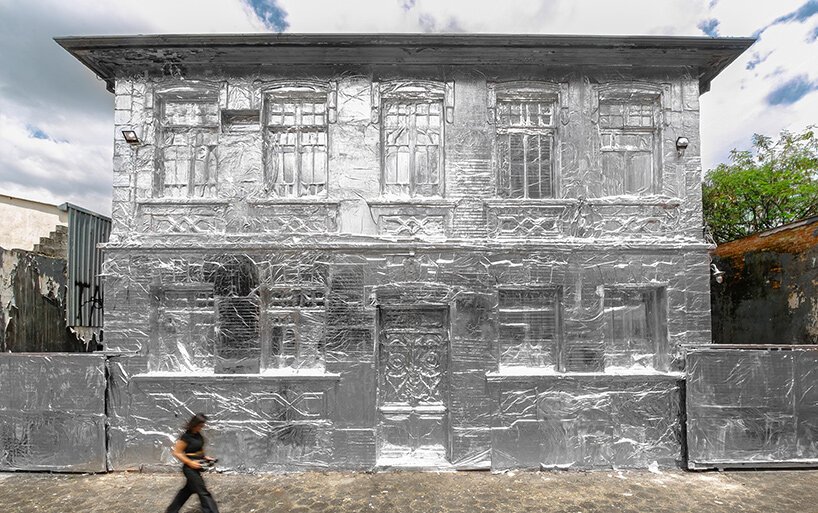
The material is ordinary thermal sheeting, laid in separate pieces and fixed with a cornstarch paste. That deliberately modest assembly matters. Instead of producing a smooth metallic object, the sheets crease around frames, cornices and surface defects, turning the existing relief into the installation’s structure. The work can therefore alter the building’s appearance without pretending to replace its fabric.
From across the street, the reflected sky and traffic break the façade into unstable patches. From above, the wrapped building reads as a small luminous interruption within the dense roofs of Pinheiros. Light changes the balance: the house can appear unusually solid and conspicuous, then begin to dissolve into the colours and movement around it.
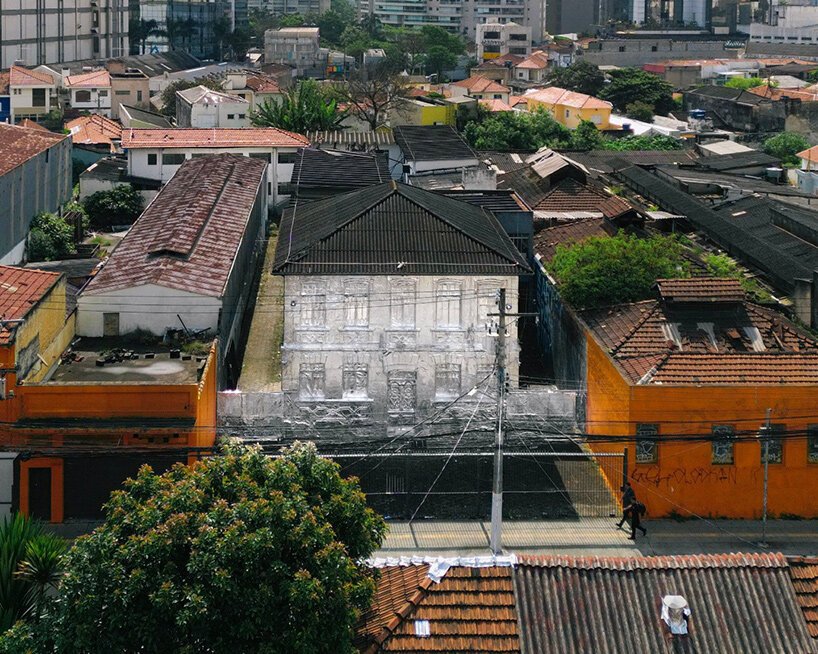
The address carries a layered civic history. Records cited in the project documentation identify it as a tuberculosis dispensary by 1945, while a 1953 state decree records the Pinheiros dispensary at the site. It later housed SUCEN, São Paulo’s former agency for controlling endemic diseases. 2878 does not reconstruct those uses. It draws attention to the physical container that has persisted while institutions and the neighbourhood changed around it.

This is the first collaboration between Vhils, known for revealing portraits by removing layers from walls, and Cidade, whose work often repositions construction materials and street elements. Here they reverse the expected gesture: addition becomes a way of revealing. The thermal blanket suggests protection, emergency and concealment at once, while the low-tech paste keeps the transformation visibly provisional.
The intervention extends the concerns of ATRITO: Arqueologia do Presente, Vhils’ exhibition at Galleria Continua São Paulo, curated by Ana Carolina Ralston and opened on 14 November 2026. Yet the street work is stronger than a simple satellite piece. Its scale is architectural, its audience is incidental, and its meaning depends on a real façade continuing to weather beneath the temporary layer.
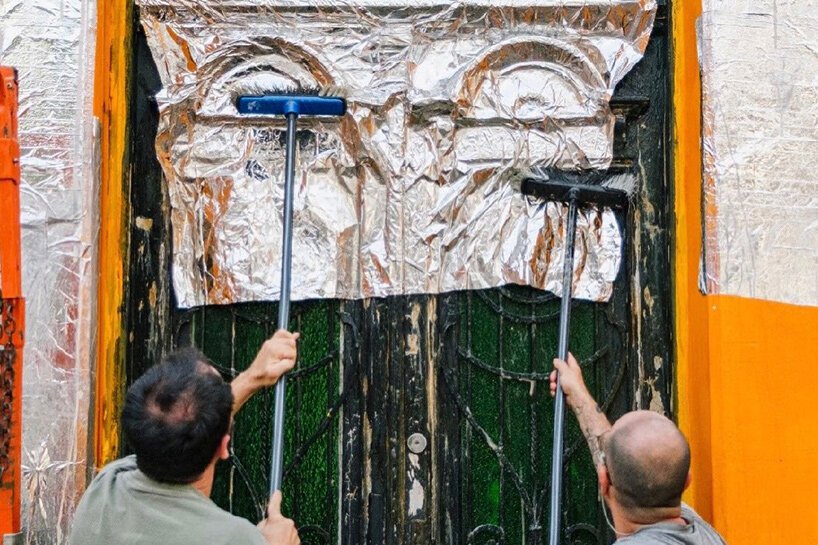
Its value lies in that precision. 2878 does not ask viewers to admire a renovated relic. It makes them notice how easily an occupied piece of urban history can become visually absent, then uses a fragile reflective membrane to return the building to public attention.
Project information and the complete photographic series were published by Designboom; the São Paulo opening and material description were also reported by Veja São Paulo. All images used here originate from Henrique Cabral’s published project photographs.